

Quick Answer
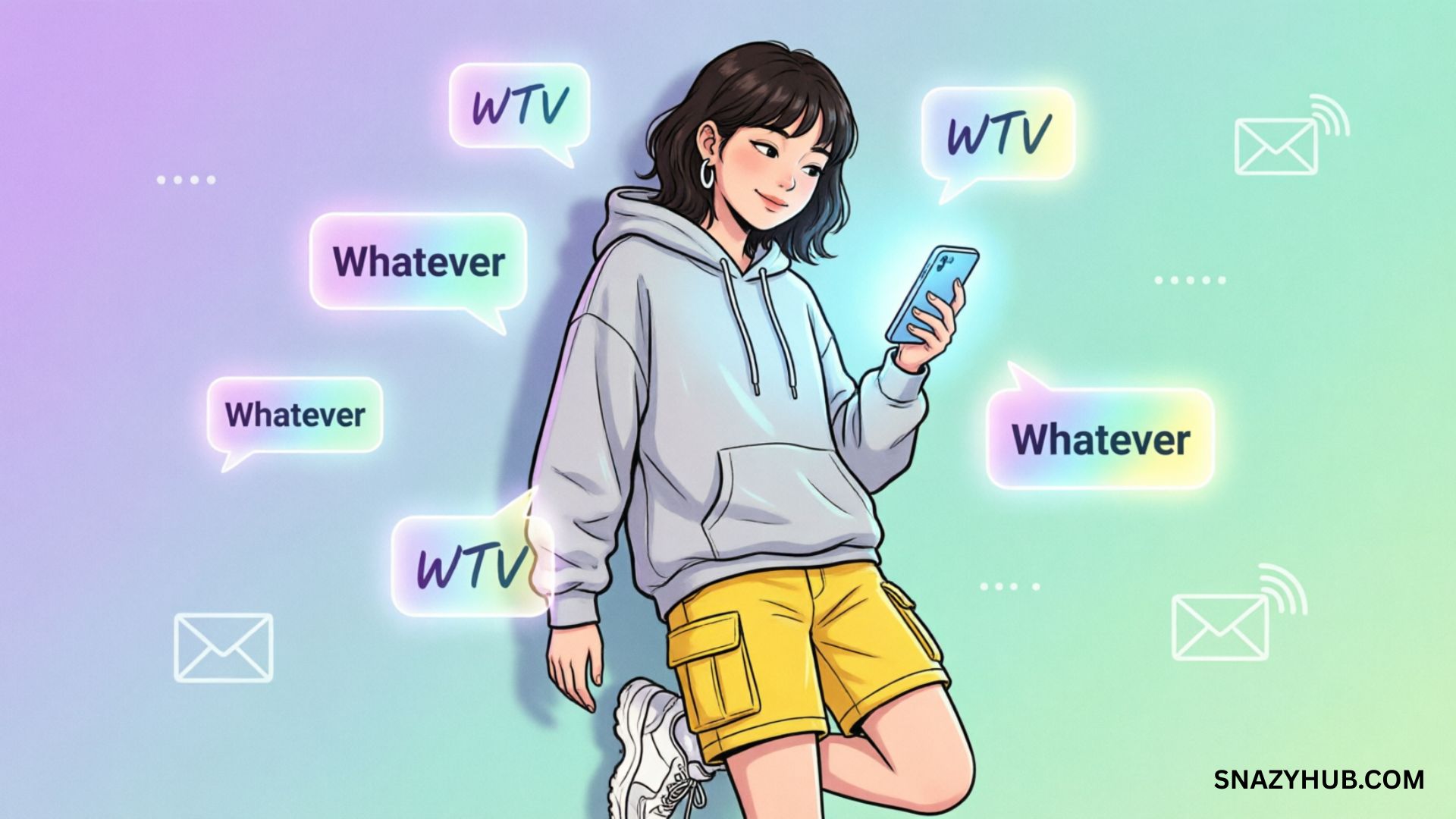
WTV meaning, in plain terms, is “whatever.” That’s it. Someone texts you “wtv” and they’re telling you, in three letters, that they’re either fine with any option or they’ve mentally checked out of the conversation. Simple as that sounds, the real answer to what does WTV mean in text depends heavily on tone, timing, and who’s sending it.
This guide covers everything: where the abbreviation came from, how casual texting language turned “whatever” into a three-letter reflex, when it’s harmless and when it’s a red flag, and how it stacks up against cousins like IDC, IDK, and NVM. By the end, you’ll know exactly how to read it — and when to type it yourself.
What Does WTV Mean in Text?
Core Meaning
At its core, WTV meaning in texting boils down to a stand-in for “whatever.” It’s used two main ways:
- Passive agreement — “Pizza or tacos tonight?” “wtv, both sound good.” No stake in the outcome, no drama.
- Dismissive tone texting — “You’re seriously not coming?” “wtv, i don’t care anymore.” Here it signals frustration, resignation, or a conversation the sender wants to end.
That range is exactly what makes this text abbreviation tricky. Unlike an emoji, it carries almost zero built-in tone. The letters stay the same whether someone’s shrugging happily or shutting you out.
Why It Matters
Understanding this abbreviation matters because it shows up constantly in modern messaging — texts, DMs, comments, group chat slang — and misreading it causes real friction. A message meant as easygoing indifference can land as cold rejection. A message meant as genuine annoyance can get brushed off as no big deal. Getting the nuance right saves you from awkward follow-up texts asking “wait, are you mad?”
The Rise of Character-Limit Shorthand
Why Texters Started Shortening Everything
Before smartphones had full keyboards and unlimited character counts, texting meant typing on a numeric keypad using T9 predictive text, where each key represented three or four letters. Early SMS plans also capped messages at 160 characters and often charged per message. That combination created real pressure to say more with less.
Character-limit shorthand origins trace directly back to this era. Phrases got chopped down not for style but for survival: “you” became “u,” “are” became “r,” and “whatever” became “wtv” or “w/e.” The habit stuck around long after phones got full QWERTY keyboards and unlimited texting plans, because by then the shorthand had become its own dialect — one built on speed and casual tone rather than character limits.
Telegraph Shorthand and Military Code Abbreviations
This isn’t a texting-only phenomenon. Compressed communication has a much older paper trail.
Telegraph shorthand history goes back to the 1800s, when operators paid by the word and developed codes to save money and time. Standard telegram abbreviations like “SOS” (not actually an acronym for anything, just chosen for its clear Morse pattern) and shorthand phrases for common greetings and sign-offs were everyday tools long before “wtv” existed.
Military code abbreviations followed a similar logic, just with higher stakes. Terms like “ASAP,” “FUBAR,” “WILCO” (will comply), and “ROGER” (message received) exist because clarity and speed mattered more than full sentences, sometimes under combat conditions. Many of these terms leaked into civilian English decades before texting existed.
Early internet chatroom slang picked up the baton in the 1990s. IRC and instant messenger platforms like AIM and ICQ gave rise to LOL, BRB, TTYL, and yes, early versions of “whatever” shortened to “w/e.” These platforms had their own soft character limits and typing-speed pressures, which pushed users toward the same compression instinct telegraph operators had a century earlier.
Mobile Texting Evolution in the 2000s
Mobile texting evolution 2000s is where “wtv” really took hold as a recognizable abbreviation. Flip phones, T9 typing, and per-message SMS pricing all pushed texters toward maximum efficiency. By the mid-2000s, “wtv” appeared regularly in teen and young-adult texting, spreading through instant messenger carryover and word of mouth rather than any single platform inventing it outright.
Here’s a quick timeline of how compressed language evolved into what we type today:
| Era | Format | Example Shorthand |
|---|---|---|
| 1800s | Telegraph | SOS, “arrive Tues stop” |
| Early-mid 1900s | Military radio | ASAP, ROGER, WILCO |
| 1990s | Chatrooms/IM | LOL, BRB, w/e |
| Early 2000s | SMS texting | wtv, u, r, gr8 |
| 2010s-today | Smartphones/social media | Same abbreviations, now stylistic choice rather than necessity |
WTV in American Texting Culture
Everyday Use
In WTV meaning in American texting culture, the abbreviation shows up most in casual, low-stakes exchanges — friend groups, sibling texts, and group chats where nobody’s proofreading. It’s rarely used in formal writing, professional emails, or first-time conversations with someone you’re trying to impress.
Common everyday examples:
- Deciding on plans: “movie or bowling?” → “wtv u pick”
- Ending a minor disagreement: “fine, wtv, let’s just go”
- Reacting to news that doesn’t affect you: “they moved the meeting again” → “wtv, i wasn’t going anyway”
Cultural Context
Why is WTV common among younger users specifically? A few real reasons stack up here. Younger texters grew up with smartphones and full keyboards, so the abbreviation isn’t really about saving keystrokes anymore — it’s about tone. Typing “whatever” in full can look like you’re taking the moment more seriously than typing “wtv,” which reads faster and more casual by design.
This ties into a broader Gen Z communication style: short, low-effort replies aren’t laziness so much as a social signal. A quick, minimal response often means the conversation isn’t high-stakes, which is its own kind of message.
The Emotional Range Behind WTV
Emotional Signals
Despite looking like a throwaway word, this emotional shorthand carries real psychological weight. Three main emotional registers show up depending on context:
- Genuine indifference — no preference, no tension, just an easy answer
- Suppressed frustration — the sender is annoyed but doesn’t want to escalate
- Full dismissal — the sender has checked out of the conversation entirely
Why It Feels Strong
Indifference slang like this feels more pointed than it looks on paper because texting strips away tone of voice, facial expression, and body language. Say “whatever” out loud with a shrug, and it reads as breezy. Type “wtv” with no punctuation after an argument, and it reads as cold — sometimes deliberately so.
This is also where emotional distance online becomes visible. A single word can create space between two people faster than a long explanation would, because it offers nothing to respond to. There’s no follow-up question built in. That silence is often the point.
When to Use WTV in Text Messages
Appropriate Situations
This abbreviation works well in:
- Casual conversations with close friends or family
- Low-stakes decisions (food, plans, minor scheduling)
- Group chats where the tone is already relaxed
- Quick reply slang situations where a fast, easy answer is genuinely all that’s needed
When to Avoid It
When should I avoid using WTV? A few situations where it backfires:
- During an active argument — it almost always reads as dismissive, even if you don’t mean it that way
- In professional communication — texting a coworker or client “wtv” undercuts your credibility
- With someone new — early-stage texting (new coworkers, new dating interests) doesn’t have the shared context to read the tone correctly
- When someone needs reassurance — replying “wtv” to “are we okay?” tends to make things worse, not better
Good texting etiquette here comes down to reading the emotional temperature of the conversation before you send it. If there’s any chance the other person is anxious, upset, or looking for a real answer, this isn’t the abbreviation for that moment.
WTV vs Other Similar Text Slang
Comparison Table
People often lump WTV in with IDC, IDK, NVM, and “meh,” but they don’t mean the same thing. Here’s the actual breakdown of IDC IDK NVM meh meaning side by side:
| Abbreviation | Full Meaning | What It Signals |
|---|---|---|
| WTV | Whatever | Indifference, dismissal, or passive agreement |
| IDC | I don’t care | Explicit lack of preference or investment |
| IDK | I don’t know | Genuine uncertainty, not indifference |
| NVM | Never mind | Dropping the subject entirely, often abruptly |
| Meh | (expression, not acronym) | Mild disappointment or lukewarm interest |
Does WTV mean the same as IDC? Not quite. IDC is a direct statement — “I don’t care” — with almost no ambiguity. WTV is vaguer by design. It can mean “I don’t care” but it can also mean “sure, that works” or “I’m annoyed and done talking.” IDC rarely carries the passive-aggressive edge that WTV sometimes does.
WTV vs IDC meaning, in short: IDC tells you the sender’s stance. WTV makes you guess it from context.
How Tone Changes the Meaning of WTV
Positive or Neutral Tone
How does tone change WTV meaning? Punctuation, capitalization, and surrounding words all shift the read:
- “wtv works, i’m easy” — relaxed, genuinely flexible
- “wtv! let’s just go with your idea” — enthusiastic agreement, almost cheerful
- “wtv 😂” — playful, often self-deprecating or joking
Negative Tone
- “wtv.” — flat, closed-off, often signals the sender is done engaging
- “WTV” in all caps — frustration or sarcasm, rarely neutral
- “wtv then” — resigned, slightly bitter, common in passive-aggressive texting
Punctuation and tone in messaging work together more than most people realize. A period after “wtv” changes the temperature of a message the same way a flat tone of voice changes a spoken sentence. Texters pick up on these micro-signals even when they can’t fully explain why a message “feels” cold.
WTV in Social Media and Group Chats
WTV Meaning in Group Chats
WTV meaning in group chats often shifts slightly from one-on-one texting. In a group setting, “wtv” tends to function as a quick way to avoid holding up a decision — nobody wants to be the person who delays plans over a minor preference, so “wtv” becomes shorthand for “don’t wait on me.”
What Does WTV Mean on Social Media
What does WTV mean on social media? On platforms like Instagram, TikTok, or X, it shows up in comments and captions with the same core meaning but often leans more performative. A caption like “wtv happens happens” signals a relaxed, unbothered persona — part of a broader wave of social media slang built around projecting effortlessness.
This connects to a real cultural pattern: digital minimalism in language, where fewer words and lowercase letters signal that someone isn’t trying too hard. Ironically, that “I don’t care” aesthetic is often carefully curated, even when the words themselves suggest indifference.
Cross-Cultural Indifference Expressions
Cross-cultural indifference expressions exist in nearly every language, which suggests “whatever” fills a genuine communication gap rather than being a purely English-language quirk. A few examples:
- French: “bof” or “peu importe“
- Spanish: “me da igual“
- German: “egal“
- Japanese: “betsu ni” (別に)
Each of these functions similarly to WTV: a low-effort way to signal indifference or close off further discussion. The informal communication style behind these expressions tends to follow the same rule across cultures — short, clipped phrases tend to read as more dismissive than longer, softer ones, regardless of the language.
Common Misunderstandings
Common Issues
The most frequent problems with this word come down to mismatched intent and interpretation:
- Sender means casual ease, receiver reads cold rejection
- Sender means frustration, receiver brushes it off as no big deal
- Sender uses it as a filler word out of habit, receiver assumes deep meaning behind it
Why It Happens
Text strips out vocal tone, so tone interpretation in text relies entirely on word choice, punctuation, timing, and prior context. Two people can send the exact same three letters and mean completely different things, and the reader has no reliable way to know which one they’re getting without asking directly. This is the root of most WTV-related arguments — not the word itself, but the guessing game around it.
How the Meaning of WTV Has Changed Over Time
Origin of the abbreviation WTV traces back to necessity — SMS character limits and slow keypad typing. Over roughly two decades, the meaning has shifted in a few clear ways:
- Early 2000s: primarily a typing shortcut, meaning stayed close to literal “whatever”
- Mid-2000s to 2010s: adopted more emotional nuance as texting became the dominant form of casual communication
- 2020s: functions as a stylistic and tonal choice as much as a shortcut, tied closely to youth-driven slang trends and the broader minimalist texting aesthetic
What started as a workaround for clunky keypads became a deliberate tone marker used by people who’ve never even touched a T9 phone.
FAQs
What does WTV mean in texting?
It means “whatever” — used to express indifference, quick agreement, or mild dismissal depending on context.
Is WTV rude in messages?
Not inherently. It’s neutral in casual, low-stakes contexts but can come across as dismissive or passive-aggressive texting when used during arguments or emotional conversations.
When should I avoid using WTV?
Avoid it during disagreements, in professional messages, with new contacts, or when someone is looking for reassurance rather than a quick answer.
Does WTV mean the same as IDC?
Not exactly. IDC directly states “I don’t care,” while WTV is more ambiguous and can mean agreement, indifference, or annoyance depending on tone.
Why do people use WTV instead of typing “whatever”?
Habit, speed, and tone. Typing the full word can read as more serious or emphatic, while “wtv” signals a lighter, more casual register.
Is WTV used by all age groups?
No. It’s most common among younger texters and heavy social media users, though older generations who grew up texting in the 2000s use it too, often with slightly less frequency.
Bottom Line
WTV meaning comes down to three letters doing the work of an entire attitude: “whatever.” Whether it reads as breezy agreement or a door closing on a conversation depends entirely on tone, punctuation, and the relationship between the people texting. Understanding that range — not just the dictionary definition — is what actually helps you use it well and avoid the awkward “wait, are you upset?” follow-up text.
Next time you see it pop up in a group chat or DM, you’ll know exactly what’s really being said.

All about grammar and text in meanings