

Making a smart business decision requires more than a quick Google search. You need reliable facts, useful context, and a clear understanding of what those details mean. Whether you’re considering an investment, evaluating a supplier, preparing for a sales meeting, or researching a competitor, a structured approach can make all the difference.
A research dossier for target company brings essential business information into one organized report. It helps you understand a company’s background, leadership, financial performance, products, market position, and potential risks. Instead of jumping between dozens of websites, you can review the evidence in one place and make more informed decisions.
However, collecting information is only half the job. You also need to verify important claims, compare competing sources, and separate facts from assumptions.
This guide explains how to build a comprehensive company research dossier, which sources to trust, how to assess business risks, and how to turn raw information into actionable insights. It also includes practical examples, comparison tables, and a reusable research template.
What Is a Research Dossier for a Target Company?
A research dossier for a target company is a structured document that gathers and analyzes information about a specific business. Its purpose is to help readers understand the organization and evaluate questions relevant to a particular business decision.
The word target simply identifies the company under investigation. It doesn’t necessarily refer to Target Corporation, the American retail company.
For example, an investor researching a technology startup may focus on its funding, revenue model, leadership, and competitors. A procurement manager examining a manufacturing supplier may prioritize financial stability, delivery performance, certifications, and operational capacity.
Both professionals need company research, but their final reports will look different.
A useful dossier typically includes:
- Company background and registration details.
- Products, services, and business model.
- Leadership, ownership, and corporate structure.
- Financial performance and funding information.
- Market trends and competitor analysis.
- Customer relationships and strategic partnerships.
- Technology, operations, and intellectual property.
- Legal, regulatory, and compliance information.
- Recent news and significant business developments.
- Risks, opportunities, and recommended next steps.
The depth of each section depends on the research objective. A short sales brief may require only a few pages, while a detailed acquisition assessment can involve extensive documentation.
The central goal is simple: turn scattered information into reliable evidence that supports a decision.
Research Dossier vs. Company Profile vs. Due Diligence
These terms often appear together, but they describe different levels of investigation.
| Feature | Company Profile | Research Dossier | Due Diligence |
|---|---|---|---|
| Main purpose | Introduce a business | Analyze a company for a specific objective | Verify important facts and obligations |
| Typical depth | Basic | Moderate to extensive | Extensive and specialized |
| Information sources | Company website and public summaries | Filings, reports, news, databases, and other evidence | Public records and authorized confidential documents |
| Financial analysis | Brief overview | Depends on the research objective | Often detailed and specialist-led |
| Risk assessment | Limited | Focused and evidence-based | Comprehensive within the engagement’s scope |
| Common users | General readers | Analysts, investors, sales teams, and business leaders | Acquisition teams, lawyers, accountants, and investors |
A company profile tells you what a business does. A dossier examines its operations, evidence, competitive position, and possible weaknesses.
Due diligence goes further by verifying material claims and investigating specific financial, legal, tax, or operational concerns.
For a major acquisition, a dossier can help determine whether deeper investigation is worthwhile. It cannot replace the formal review required before completing the transaction.
Why Is a Target Company Research Dossier Important?
A business can have an impressive website, recognizable customers, and ambitious growth plans while still facing significant challenges. Attractive branding doesn’t guarantee profitability, and rapid expansion doesn’t always indicate financial strength.
A structured research dossier helps you look beyond appearances.
Improve Business Decision-Making
Before committing money, time, or resources, you need to understand the company involved. Research can help you evaluate whether its business model fits your objectives and whether important risks deserve further attention.
Imagine a supplier offering prices well below the market average. At first, the offer looks attractive. However, your research uncovers repeated delivery complaints and dependence on a single manufacturing facility.
Those findings don’t automatically mean the supplier is unsuitable. They do suggest that you should investigate its delivery capacity and business continuity plans before signing a contract.
Identify Sales and Partnership Opportunities
Company research helps sales professionals understand a potential customer’s priorities before reaching out.
Suppose a business announces plans to open five new regional offices. That expansion could create demand for logistics software, cybersecurity services, office equipment, or additional staffing support.
The announcement provides a relevant starting point for research. It doesn’t prove the business intends to purchase any particular service.
By connecting public developments with genuine customer needs, sales teams can prepare more useful questions and avoid generic outreach.
Reduce Investment and Acquisition Risks
Investors need to understand more than a company’s products and public reputation. They must also examine its financial condition, ownership, liabilities, market position, and growth prospects.
A research dossier can reveal warning signs early. These might include declining margins, heavy customer concentration, significant regulatory exposure, or increasing dependence on borrowed money.
Such findings help investors decide which questions require deeper investigation before committing capital.
Support Hiring and Vendor Evaluation
Job seekers can research a company’s strategy, products, leadership, and recent announcements before an interview. This preparation helps them ask informed questions about the role and the organization’s direction.
Procurement teams can use the same process to compare vendors. Reviewing financial indicators, certifications, public customer feedback, and operational capabilities can make supplier selection more consistent.
Essential Components of a Research Dossier for a Target Company
A strong dossier follows a logical structure. Each section should answer a specific question and contribute to the overall research objective.
Company Overview and Identity
Start by confirming exactly which company you’re researching. This basic step prevents mistakes that can undermine the entire report.
Record the legal business name, official website, headquarters, registration jurisdiction, industry, founding date, and operating locations. Include parent companies and subsidiaries when reliable records establish those relationships.
Businesses sometimes operate under different legal and commercial names. Two organizations may also share similar names without having any connection.
For US businesses, state registries can help verify certain registration details. Public companies and other reporting entities may have filings available through the SEC’s EDGAR database.
A company snapshot can include the following fields:
| Information | What to Record |
|---|---|
| Legal name | Registered company name |
| Official website | Verified company domain |
| Industry | Primary business sector |
| Headquarters | Confirmed primary location |
| Ownership structure | Public, private, subsidiary, or another verified arrangement |
| Founding date | Year supported by a reliable source |
| Geographic reach | Countries or regions served |
| Research date | Date the information was checked |
Use verified details rather than filling gaps with assumptions. If the company’s founding date or ownership structure remains uncertain, document the limitation and continue investigating.
Company History and Major Milestones
A company’s history often explains its current strategy. Major milestones can reveal how the organization developed its products, entered new markets, and responded to competitive pressure.
Review its founding, product launches, acquisitions, partnerships, leadership changes, restructuring efforts, and geographic expansion.
Create a chronological timeline that includes dates and supporting sources. This makes it easier to identify patterns and understand how the business evolved.
For example, a fictional software company might launch its first product in 2020, secure outside funding in 2023, and enter two international markets in 2025.
Those events could indicate a shift toward expansion. However, further evidence would be necessary to determine whether that expansion has improved profitability or market share.
Products, Services, and Business Model
Understanding what a company sells is only the beginning. You also need to examine its customers, pricing structure, distribution channels, and revenue sources.
Common business models include:
- Subscription: Customers pay recurring fees for continued access.
- Transactional: The company earns revenue from individual purchases.
- Licensing: Customers pay for permission to use software or intellectual property.
- Advertising: Revenue comes from selling advertising placements.
- Marketplace: The business connects buyers and sellers.
- Service-based: The company charges for consulting, implementation, maintenance, or professional expertise.
Some organizations combine several models. A software provider might sell subscriptions while charging separately for onboarding and premium support.
Also, examine customer concentration. A company that depends heavily on a few large clients may face substantial revenue pressure if one relationship ends.
Leadership and Ownership Structure
Leadership decisions influence business strategy, hiring, spending, and long-term priorities. Ownership can also affect governance and decision-making authority.
Identify founders, executives, directors, parent organizations, and major shareholders where reliable sources disclose those details.
Public-company annual reports and proxy statements can provide information about executive responsibilities, governance arrangements, and shareholder interests. The SEC EDGAR search portal is a useful starting point.
Private companies require more careful interpretation. Registration documents may identify officers or registered agents without establishing who ultimately owns or controls the business.
| Person or Entity | Information to Research | Why It Matters |
|---|---|---|
| Founder | Background and original business purpose | Provides context about the company’s origins |
| CEO | Responsibilities and experience | Helps explain executive direction |
| CFO | Financial leadership background | Relevant to financial management |
| Board members | Governance roles | Helps assess oversight |
| Major shareholders | Publicly disclosed ownership | May influence strategic decisions |
Leadership changes also deserve attention. A new executive could introduce different priorities or reorganize departments, but those outcomes shouldn’t be assumed without supporting evidence.
Financial Performance and Business Health
Financial analysis often provides some of the clearest evidence about a company’s condition. Still, one revenue figure rarely tells the whole story.
Review several reporting periods when possible. Examine revenue, operating income, net income, cash flow, debt, liquidity, and major financial obligations.
For publicly traded US companies, annual and quarterly filings provide a strong foundation. You can locate relevant documents through the SEC’s company filing search.
Important indicators include:
- Revenue growth: Measures changes in sales over time.
- Operating margin: Shows operating income as a percentage of revenue.
- Net profit margin: Measures net income relative to revenue.
- Operating cash flow: Indicates how much cash normal business activities generate.
- Debt: Helps reveal borrowing obligations and financial pressure.
- Liquidity: Indicates the ability to meet short-term obligations.
Consider this hypothetical example:
| Metric | Year One | Year Two |
|---|---|---|
| Revenue | $10 million | $12 million |
| Operating income | $1.5 million | $1.2 million |
| Operating margin | 15% | 10% |
| Operating cash flow | $1.4 million | $1.1 million |
Revenue increased by 20%, yet operating income fell by 20%. The operating margin also declined from 15% to 10%.
This pattern deserves investigation. Rising expenses, pricing pressure, or changes in product mix could explain the results, but the figures alone don’t establish the cause.
Private companies may not publish complete financial statements. Use available disclosures and label estimates clearly rather than presenting them as confirmed figures.
Market Position and Industry Analysis
A company’s performance depends partly on the market it serves. Even a well-managed business can struggle when customer demand declines or competitors introduce better alternatives.
Research the company’s industry, target customers, market size, growth drivers, regulatory environment, and emerging technologies. Then connect those trends to the company’s actual products and geographic reach.
The Library of Congress company research guide explains that research methods and useful sources vary according to company size, location, and ownership structure. Smaller private businesses can require more creative research because they disclose less information.
Research Guides at Library of Congress
+1
Consider these questions:
- Is demand for the company’s products increasing or decreasing?
- Are customers moving toward cheaper or more convenient alternatives?
- Does the business operate in a growing market or a mature industry?
- Could regulatory changes increase its operating costs?
- Does new technology threaten its existing products?
- What advantages distinguish it from competing businesses?
Avoid relying on broad market statistics without explaining their relevance. A global industry worth billions doesn’t automatically indicate that a small regional company has substantial growth potential.
Competitor Research and Competitive Intelligence
Competitor research shows how the target company compares with other businesses serving similar customers. It can also uncover market opportunities, pricing differences, and strategic weaknesses.
Identify direct competitors offering comparable products and indirect competitors solving the same customer problem through different methods.
For example, a project management platform competes with similar software products. However, spreadsheets and internal tools may also compete for the same customers.
Use consistent criteria when comparing businesses.
| Comparison Factor | Target Company | Competitor A | Competitor B |
|---|---|---|---|
| Main offering | Verified products | Verified products | Verified products |
| Target audience | Primary customer segment | Primary customer segment | Primary customer segment |
| Pricing | Published pricing | Published pricing | Published pricing |
| Distribution | Sales channels | Sales channels | Sales channels |
| Competitive advantage | Evidence-based assessment | Evidence-based assessment | Evidence-based assessment |
| Potential weakness | Documented concern | Documented concern | Documented concern |
Compare similar measurements and reporting periods. Otherwise, the results may create a misleading picture.
For instance, comparing one company’s annual revenue with another company’s quarterly revenue would distort the analysis.
Customers, Partnerships, and Business Relationships
Customer relationships reveal how a company reaches the market and where it might face dependency risks.
Look for publicly confirmed customers, case studies, supplier relationships, distribution agreements, and strategic partnerships. Company announcements can establish that a relationship was announced, while independent sources may help explain its significance.
Be careful when interpreting the evidence. A customer logo on a website doesn’t necessarily prove that a commercial relationship remains active.
Likewise, a partnership announcement doesn’t establish how much revenue either company receives from the arrangement.
Review public customer feedback for recurring concerns involving reliability, delivery, pricing, product quality, and customer support. Several independent reports of the same issue may justify further investigation, although reviews alone rarely establish the full picture.
Technology, Operations, and Intellectual Property
A company’s technology and operating capabilities can influence its efficiency, security, and ability to grow.
Research its publicly disclosed software platforms, manufacturing facilities, distribution systems, patents, and trademarks. For US intellectual property research, the United States Patent and Trademark Office provides official resources.
Operational research should also examine potential dependencies.
Ask whether the company relies heavily on one supplier, one cloud provider, a single manufacturing location, or a critical distribution partner. Such dependencies can create vulnerabilities when disruptions occur.
Public job postings may provide additional clues about a company’s priorities. For example, hiring several cybersecurity specialists could indicate investment in security capabilities. However, job advertisements alone don’t establish the company’s current technical maturity.
Legal, Regulatory, and Compliance Research
Legal research helps identify documented disputes, regulatory concerns, and obligations that could affect a company’s operations.
Depending on the industry, relevant records may include court proceedings, enforcement actions, bankruptcy filings, licensing information, sanctions records, and intellectual property disputes.
For US federal litigation, PACER provides access to federal court records. State court systems and specialized regulatory databases may be necessary for other matters.
Every legal finding needs context. A lawsuit doesn’t prove wrongdoing, and allegations aren’t equivalent to a final judgment.
Record the relevant parties, filing dates, current status, and outcome when available. Distinguish between pending proceedings, dismissed claims, settlements, and final judgments.
For regulated businesses, also check whether the company holds the licenses or approvals required for its activities.
Recent News and Strategic Developments
Recent developments can reveal priorities that older company profiles miss.
Review significant announcements from the previous 12–24 months, including acquisitions, funding rounds, product launches, executive appointments, layoffs, and market expansions.
For each event, record:
- The announcement or event date.
- The original source and publication date.
- The main development.
- Its potential business significance.
- Any follow-up research required.
Look for patterns rather than treating every announcement as an isolated event.
Suppose a company appoints a new operations executive, opens several regional offices, and advertises multiple logistics positions. Together, these signals may suggest an expansion of its operating capacity.
That remains a hypothesis until additional evidence confirms the company’s plans.
Risk Assessment and Business Opportunities
A strong research dossier doesn’t simply collect facts. It explains which findings deserve attention and why.
Create a risk register that connects each concern to supporting evidence, potential consequences, and recommended follow-up.
| Risk or Opportunity | Evidence to Review | Potential Impact | Recommended Action |
|---|---|---|---|
| Customer concentration | Disclosed customer mix | Revenue instability | Investigate diversification |
| Rising debt | Financial statements | Greater financing pressure | Review repayment obligations |
| New market expansion | Official announcements | Growth opportunity or execution risk | Assess market demand and costs |
| Leadership turnover | Company disclosures | Strategic uncertainty | Review transition plans |
| Growing product demand | Sales disclosures or credible market research | Expansion potential | Examine capacity and margins |
| Supplier dependency | Public operating information | Business continuity concerns | Identify alternatives |
You can rate each risk as low, medium, or high based on its likelihood and potential impact. Explain the reasoning behind each rating so readers can understand how you reached the conclusion.
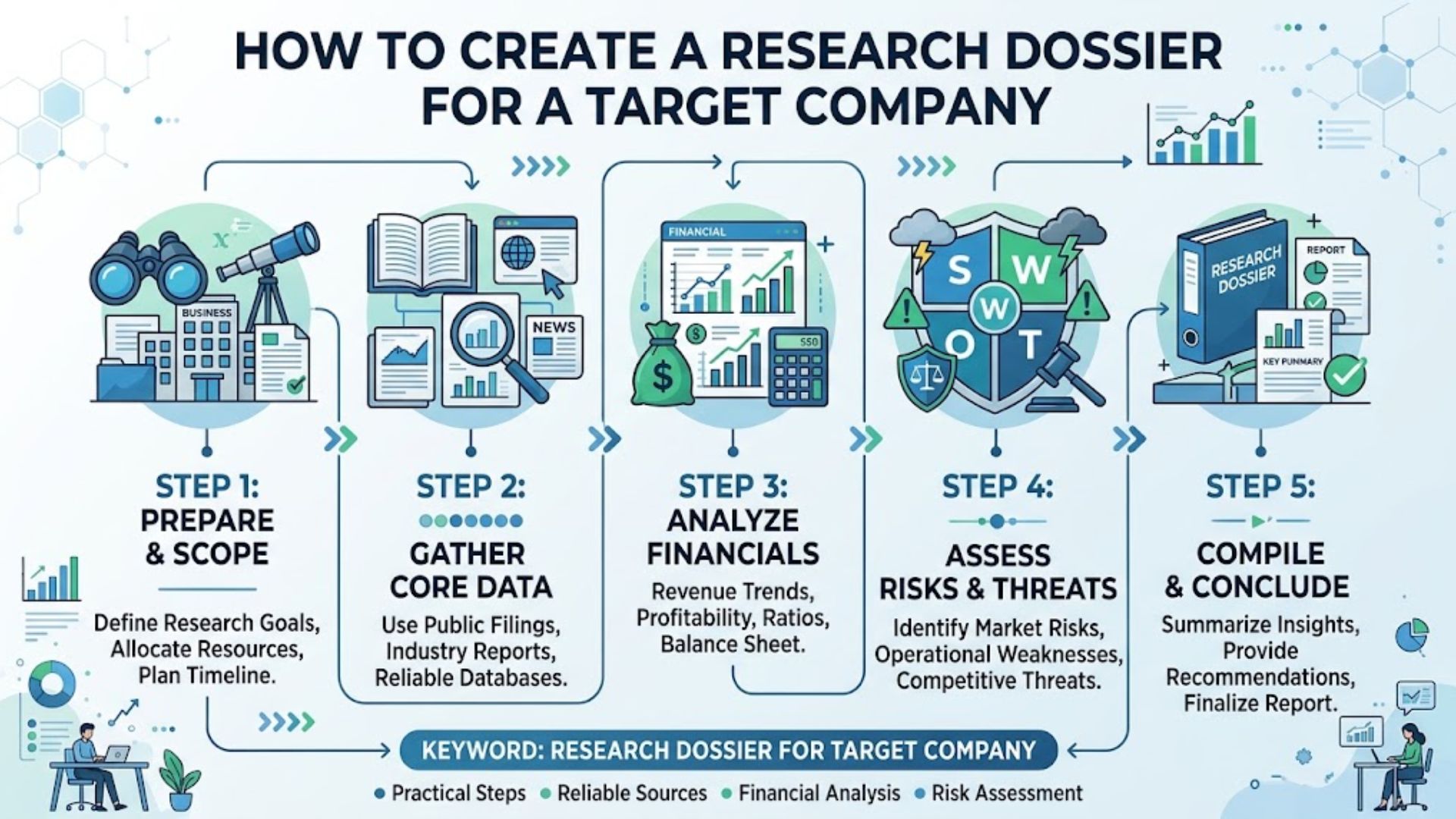
How to Build a Research Dossier for a Target Company Step by Step
A repeatable research process makes your findings easier to verify and update. It also prevents the project from becoming an endless search for unrelated information.
Define the Research Objective
Start with one sentence describing the decision your research should support.
Examples include:
- Determine whether a supplier meets long-term business requirements.
- Prepare for a sales meeting with a potential enterprise customer.
- Decide whether an acquisition target deserves further investigation.
- Evaluate a company’s competitive position before entering its market.
Your objective determines which information deserves priority. Without one, even a large collection of facts can produce very little practical value.
Confirm the Company’s Identity
Verify the legal name, official website, registration jurisdiction, and relevant corporate relationships.
Check whether the business operates under a different trading name or belongs to a larger corporate group. For international companies, identify the appropriate national registry.
This step prevents a surprisingly common mistake: combining information from two unrelated businesses that happen to share a name.
Gather Primary Sources First
Primary sources include official company filings, annual reports, government records, court documents, and company announcements.
Start with these materials before consulting summaries or commentary. Then use independent reporting and industry research to add context.
Useful resources include:
- SEC EDGAR for US public-company filings.
- USPTO for US patent and trademark information.
- SAM.gov for relevant federal contracting and registration information.
- PACER for US federal court records.
- Library of Congress company research guides for research strategies and additional resources.
Each database serves a different purpose. Don’t assume one source can answer every question about a company.
Maintain an Evidence Log
Record important findings as you collect them. Include the claim, source URL, publication date, date checked, and verification status.
For significant claims, seek independent confirmation whenever possible.
| Research Claim | Source | Verification Status | Next Step |
|---|---|---|---|
| Company registration | Government registry | Checked against official record | Record entity details |
| Annual revenue | Annual report | Verified for stated fiscal year | Compare earlier periods |
| Employee count | Company disclosure | Confirmed as of reporting date | Check for newer figures |
| Market share | Industry report | Estimate | Review methodology |
| Customer relationship | Company announcement | Announcement confirmed | Check current status |
An evidence log makes the dossier easier to maintain. It also helps other readers understand which conclusions rest on strong evidence and which require additional verification.
Analyze the Findings
After gathering the information, ask what each important finding means.
Revenue growth becomes more useful when compared with operating margins, cash flow, and industry performance. A new partnership matters more when you understand its scope and commercial purpose.
Use this simple framework for major findings:
- Finding: What does the evidence show?
- Interpretation: Why might it matter?
- Confidence: How reliable and current is the evidence?
- Implication: Which decision could it affect?
- Next step: What additional information would improve the conclusion?
This method turns raw information into practical analysis.
Write the Executive Summary Last
Although the executive summary appears near the beginning of the finished document, prepare it after completing the research.
Summarize the company’s identity, business model, financial condition, competitive position, recent developments, and major risks.
Keep the summary focused on your original objective. An investor needs different conclusions from a sales representative or procurement manager.
Best Sources for a Target Company Research Dossier
The quality of your dossier depends heavily on its sources. Prioritize information that is relevant, traceable, current, and appropriate for the claim being evaluated.
| Source Type | Examples | Best Use |
|---|---|---|
| Official company documents | Annual reports, product pages, press releases | Business activities and company statements |
| Government records | Business registries and regulatory filings | Legal identity and formal disclosures |
| Financial sources | Financial statements and earnings reports | Revenue, profitability, debt, and cash flow |
| Court and regulatory records | Court filings and enforcement announcements | Legal and compliance matters |
| Industry research | Trade associations and market studies | Market trends and competitive context |
| Established news organizations | Business and industry publications | Independent reporting on developments |
| Customer feedback | Review platforms and published case studies | Identifying possible service patterns |
| Professional profiles | Official biographies and career histories | Leadership and role verification |
Why Primary Sources Deserve Priority
A regulatory filing can establish what a company reported for a particular financial period. A news article might summarize that information, while a social media post could repeat it without context.
Whenever possible, trace important claims back to their original sources.
However, primary sources aren’t automatically neutral. Company marketing materials often emphasize strengths, while independent reporting can add context or highlight conflicting evidence.
The Library of Congress company research guide offers additional guidance on selecting sources and adapting research methods to different businesses.
Research Guides at Library of Congress
+1
A Practical Research Dossier Template You Can Reuse
A reusable template makes it easier to research several companies consistently. Copy the structure below into a document or spreadsheet and adapt it to your needs.
Company Research Template
Research objective: State the business decision this report will support.
Company identification
- Legal name:
- Official website:
- Headquarters:
- Industry:
- Registration jurisdiction:
- Ownership structure:
- Research date:
Executive summary
- Main business activities:
- Key findings:
- Major risks:
- Potential opportunities:
- Outstanding questions:
Business and financial analysis
- Products and services:
- Customer segments:
- Business model:
- Revenue and profitability:
- Cash flow and debt:
- Funding and ownership:
Leadership and operations
- Key executives:
- Board and governance:
- Operating locations:
- Important suppliers or partners:
- Technology and intellectual property:
Market and competitors
- Main market:
- Industry trends:
- Direct competitors:
- Indirect competitors:
- Competitive advantages:
Legal and risk assessment
- Relevant litigation:
- Regulatory matters:
- Financial concerns:
- Operational risks:
- Reputation concerns:
- Verification gaps:
Recent developments
- Event and date:
- Source:
- Business significance:
- Follow-up required:
Final assessment
- Most important conclusions:
- Recommended next steps:
- Information requiring professional verification:
- Next review date:
Example of an Evidence-Based Finding
Imagine you’re researching a fictional software company called Northstar Systems.
Its annual financial statements show that revenue increased from $20 million to $24 million in one year. Operating income, however, fell from $3 million to $2.4 million.
A useful dossier entry could read:
Finding: Revenue increased by 20%, while operating income declined by 20%.
Interpretation: The company generated more sales but earned less operating profit. Higher expenses or changes in product mix may explain the difference.
Evidence: The company’s financial statements for both reporting periods.
Confidence: High for the reported figures; the cause remains unverified.
Next step: Review expense categories, management commentary, and cash flow before drawing a conclusion.
This example demonstrates a critical principle: report what the evidence establishes, then identify what still needs investigation.
The company and figures are hypothetical. They illustrate the research method rather than describe an actual business.
How to Tailor Company Research to Different Business Goals
The best dossier matches its depth and emphasis to the decision at hand.
For Investors
Investors should prioritize revenue quality, profitability, cash generation, debt, valuation, ownership, and competitive durability.
They should also examine disclosed risk factors and management’s explanations of business performance. Strong revenue growth can hide weak margins or unsustainable spending.
Public filings provide a starting point, but investment decisions may require deeper accounting and valuation analysis.
For Mergers and Acquisitions
Acquisition teams need to investigate ownership, liabilities, contracts, financial records, litigation, intellectual property, and operational compatibility.
A preliminary dossier can help determine whether further discussions make sense. It can also identify questions for legal, financial, tax, and technical specialists.
However, public information rarely provides the complete picture required to approve an acquisition. Formal due diligence should test important claims using authorized records and professional review.
For Sales and Business Development
Sales teams should focus on company priorities, recent developments, leadership, potential customer needs, and relevant buying roles.
Suppose a business announces a major expansion. A supplier offering logistics software could investigate whether that expansion creates a relevant operational challenge.
The sales approach should connect the offering to a plausible business need rather than assume the company has a problem.
For Procurement and Vendor Evaluation
Procurement teams should examine financial resilience, service quality, operational capacity, compliance, and supplier dependencies.
They can compare vendors using consistent evaluation criteria. This makes the selection process easier to explain and justify.
For critical suppliers, the dossier should also identify contingency options and the evidence needed to assess business continuity.
For Job Seekers
Candidates can research company strategy, leadership, products, workplace policies, and recent announcements before an interview.
Employee reviews may offer useful clues, but individual experiences don’t necessarily represent the entire organization. Look for recurring themes and compare them with other evidence.
A well-prepared candidate can use the research to ask informed questions about team priorities, management expectations, and the company’s direction.
For Competitive Intelligence
Competitive intelligence helps businesses understand rival products, pricing, customer segments, partnerships, hiring patterns, and public strategic moves.
Use lawful, ethical research methods and publicly available information. Avoid misrepresenting your identity, accessing restricted systems, or seeking confidential information without authorization.
The objective is to understand the competitive environment, not to cross legal or professional boundaries.
Common Mistakes to Avoid When Preparing a Company Research Dossier
Even extensive research can produce weak conclusions when basic verification steps get overlooked.
Watch out for these common mistakes:
- Researching the wrong company: Confirm the legal entity and official domain first.
- Using outdated figures: Record reporting periods for revenue, employee counts, and market estimates.
- Treating estimates as facts: Label third-party estimates and distinguish them from official disclosures.
- Ignoring conflicting evidence: Investigate disagreements rather than choosing the most favorable figure.
- Confusing allegations with proven misconduct: Check the status and outcome of legal proceedings.
- Collecting information without a purpose: Focus on facts that support the decision you’re evaluating.
- Overlooking negative evidence: Examine weaknesses as carefully as strengths.
- Failing to cite sources: Record links and dates so readers can verify important claims.
- Making unsupported assumptions: Separate documented facts from analytical interpretations.
- Ignoring privacy and confidentiality: Use authorized information and respect applicable laws.
One particularly costly mistake involves confusing correlation with causation. A company increasing its hiring might be expanding, replacing departing employees, or restructuring a department. Hiring data alone doesn’t establish which explanation is correct.
How to Evaluate the Quality of Your Research Dossier
Before sharing your report, check whether it provides a reliable foundation for the intended decision.
Use this quality-control checklist:
- The research objective and scope are clearly stated.
- The correct legal entity has been identified.
- Important facts include credible source links.
- Financial figures include reporting periods and relevant units.
- Estimates are labeled appropriately.
- Important claims have been cross-checked where possible.
- Recent developments include dates.
- Competitors are compared using consistent criteria.
- Material risks and opportunities are clearly explained.
- Allegations and unresolved questions are distinguished from established facts.
- Information gaps are documented rather than concealed.
- The report includes a last-reviewed date and recommended next steps.
A good dossier doesn’t need to answer every conceivable question. It needs to answer the important questions accurately and reveal where further research is necessary.
How AI Tools Can Help With Company Research
AI tools can speed up several parts of the research process. They can summarize long reports, organize source material, compare financial tables, identify repeated themes, and help prepare a structured first draft.
However, AI-generated summaries can omit context or misinterpret information. They may also combine details from different companies with similar names.
Use AI as a research assistant rather than an unquestioned authority.
A sensible workflow includes these steps:
- Collect original documents and reliable sources.
- Use AI to organize information and summarize relevant passages.
- Check important claims against the original documents.
- Verify calculations and reporting periods independently.
- Add source links and explain uncertainties.
- Review the final analysis before using it for a consequential decision.
Never include confidential company information in an external tool unless you have permission and its data-handling arrangements meet your requirements.
The strongest workflow combines automation with human judgment. Technology can help process information, but evidence still needs careful interpretation.
Frequently Asked Questions
What is a research dossier for a target company?
A research dossier for a target company is an organized report examining a business’s identity, operations, leadership, financial position, market, competitors, and risks. It helps investors, sales teams, procurement professionals, and other decision-makers evaluate a company using documented evidence.
How long should a company research dossier be?
The appropriate length depends on the purpose. A short interview brief might fit into one or two pages, while a detailed acquisition screening report could require dozens of pages.
Focus on relevance rather than length. Include enough evidence to support the decision without burying important findings in unnecessary detail.
Can you create a dossier for a private company?
Yes. You can investigate a private company using its official website, available registration records, public announcements, credible news reports, patent databases, and other lawful sources.
However, private companies often disclose less financial information than publicly traded businesses. Clearly label estimates and document information gaps instead of inventing figures.
What are the most reliable sources for company research?
Official regulatory filings, government registries, audited financial statements, and court records are valuable sources for the claims they document. Company announcements can establish what a business has publicly stated, while independent reporting adds context.
The best source depends on the question. A trademark database may verify a registered mark, but it won’t establish whether a company’s business model is profitable.
How often should a research dossier be updated?
Update the dossier before important meetings, investments, supplier decisions, or acquisition discussions. For companies you monitor regularly, quarterly reviews provide a useful starting point.
Major events such as acquisitions, executive departures, financial disclosures, regulatory actions, or product launches may require an earlier update.
Is a research dossier the same as due diligence?
No. A research dossier organizes evidence and identifies issues that may affect a decision. Formal due diligence involves deeper verification, often using authorized confidential documents and specialist financial, legal, tax, or operational analysis.
A dossier can guide due diligence, but it shouldn’t replace it.
Can a research dossier identify business risks?
Yes. It can highlight documented concerns involving financial performance, competition, leadership, customer concentration, legal matters, cybersecurity, or operational dependencies.
However, a dossier identifies and evaluates potential risks. It cannot guarantee that every risk has been discovered.
Conclusion: Turn Company Research Into Actionable Insights
A well-prepared research dossier gives you a clearer understanding of a business before you make an important decision. It brings company facts, financial evidence, competitive analysis, recent developments, and risk assessments into one organized resource.
The most effective approach starts with a clear objective. From there, verify the company’s identity, prioritize reliable sources, document important claims, and analyze what the evidence means.
Remember that a long report isn’t automatically a good report. Accuracy, relevance, transparency, and useful recommendations matter far more than page count.
Whether you’re evaluating a supplier, preparing for a sales meeting, researching an investment, or screening an acquisition target, a research dossier for target company can help you ask better questions and recognize important warning signs.

All about grammar and text in meanings