

Quick Answer
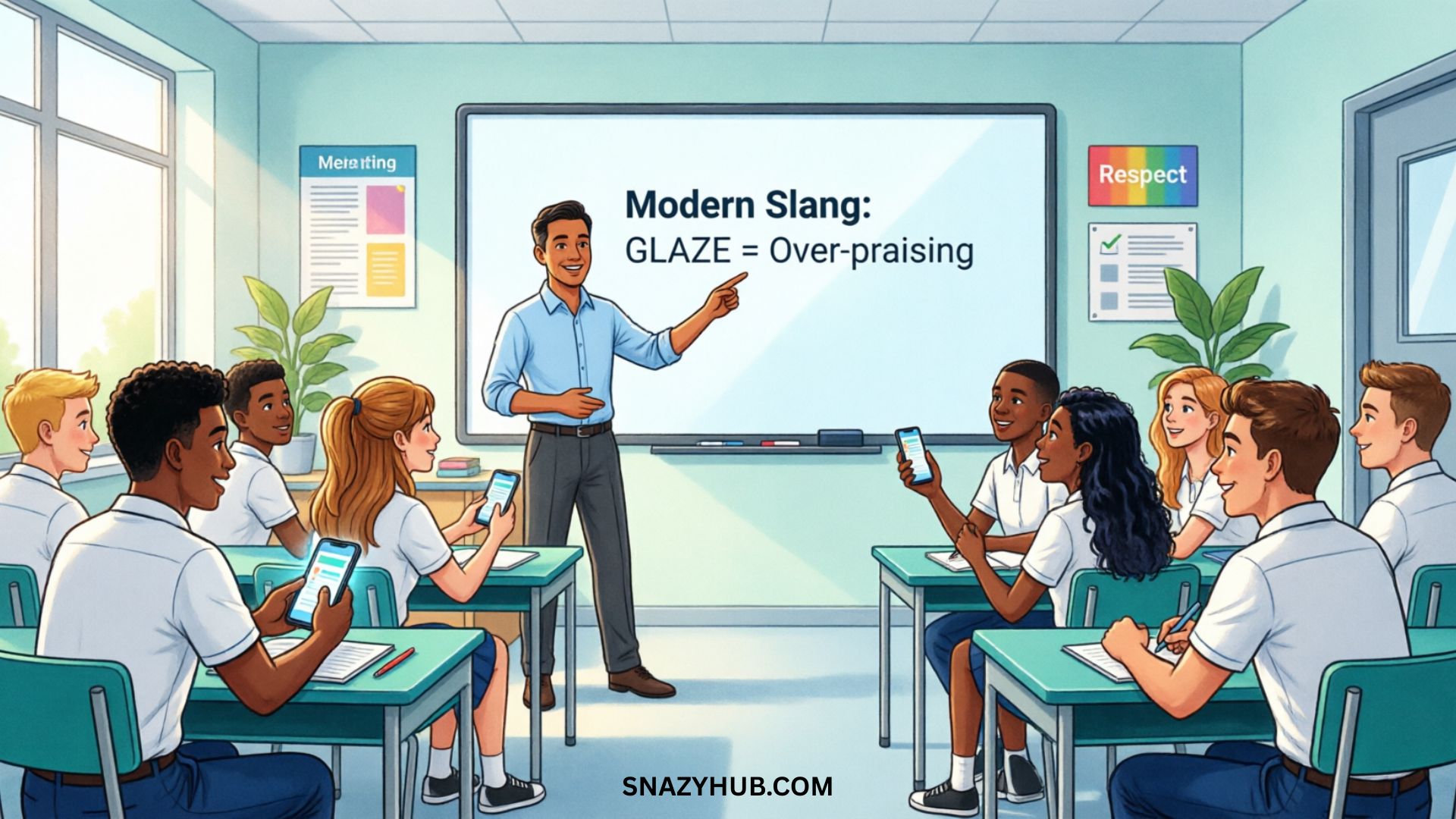
Glaze meaning slang boils down to one thing: overpraising someone. When you “glaze” a person, you’re piling on compliments, hype, or admiration to a point where it stops feeling genuine and starts feeling like a performance. A “glazer” is someone who does this on repeat — the friend who can’t stop hyping up their favorite streamer, the fan who defends a celebrity no matter what they do, the guy in your group chat who won’t shut up about his girlfriend’s cooking.
That’s the short version. The longer version — where it came from, how it splits from an older meaning tied to glazed eyes, and why it exploded across TikTok slang terms in the last few years — takes a bit more unpacking.
Where You’ll See It
You’ll run into glaze internet slang basically anywhere people talk about other people online. It’s everywhere in gaming chat slang, where teammates rib each other for hyping a clutch play too hard. It shows up constantly in influencer praise culture, where comment sections under a creator’s post fill up with the same three or four superlatives repeated a hundred times. Sports Twitter uses it to call out fans who won’t admit their favorite player had a bad game. And it’s a staple of ordinary group texts, where “glazing him/her” is just a way of teasing a friend who’s a little too obsessed with their new partner. The tone shifts depending on where you see it, but the core idea — exaggerated admiration aimed at another person — stays the same everywhere it pops up.
The Core Meaning, Explained
What Counts as “Glazing”
So what does glaze mean in slang? At its core, it describes praise that’s gone past the point of being believable. A single compliment isn’t glazing. A pattern of over-the-top compliments is. Here’s a typical exchange that shows the difference:
Friend 1: “He dropped 40 points last night, he’s literally unstoppable, best player in the league right now, no debate.” Friend 2: “Bro, stop glazing. He missed the game-winner.”
Friend 1 isn’t lying, exactly — he’s just laying it on way thicker than the situation calls for. That gap between the praise and the reality is what makes it glazing instead of just a compliment. Common signs someone’s glazing:
- Compliments that repeat the same superlatives (“the greatest,” “unmatched,” “literally the best ever”)
- Praise that ignores an obvious flaw or counterpoint
- Defending someone reflexively, even when the criticism is fair
- Showing up specifically to hype one person across multiple posts or conversations
Playful vs. Genuine Criticism
Here’s where a lot of people get tripped up. The exact same word can be a joke between friends or a real accusation, and the only thing that tells you which one it is happens to be context. Among friends, “you’re glazing” is almost always affectionate — it’s a way of saying “I see you, and it’s a little much, and that’s funny.” Aimed at a stranger, especially in a public comment section, it usually carries more weight. It’s less “haha you like this person a lot” and more “your judgment is compromised because you won’t stop simping in public.” Reading the room — who’s saying it, and to whom — matters more than the word itself.
Where the Word Comes From
The Literal Sense: Glaze Slang vs. Literal Meaning (Donut/Pottery)
Before it meant anything about people, “glaze” was a cooking and craft term. A glazed donut has a thin, shiny sugar coating over its whole surface. Glazed pottery gets a liquid coating that’s fired to a hard, glossy finish. In both cases, the glaze covers something completely and makes it shine. That image — a full, glossy coating over the entire surface — is exactly what got borrowed for the slang meaning.
Origin of Glaze Slang From Glazed Eyes
There’s actually a second, older thread that gets tangled up with the overpraising sense, and it’s worth separating out. Glazed eyes meaning, in plain English, describes a dull, unfocused stare — the look someone gets when they’re tired, bored, or zoning out. According to Collins Dictionary, glazed eyes signal an expression that’s “dull or dreamy,” usually from exhaustion or trouble concentrating. That sense of the word has circulated online since at least the late 2010s, describing someone who’s spaced out or lost in a daydream — “I was so glazed during that lecture I don’t remember a word of it.”
That’s a genuinely different usage from the overpraising sense, even though both trace back to the same root word. The “zoned out” meaning describes your own mental state. The “overpraising” meaning describes how you’re treating someone else. They coexist online, but by 2025 and 2026, the overpraising sense is the one dominating TikTok slang terms and gaming chats — it’s the version most people mean when they say “stop glazing” today.
How It Became Digital Slang
The semantic shift makes intuitive sense once you see both source meanings side by side:
| Source meaning | What it contributes to modern slang |
|---|---|
| Glazed donut / pottery | The idea of a full, glossy coating — applied to compliments instead of food or ceramics |
| Glazed eyes | The idea of losing yourself in something — feeding into the “obsessed, can’t see straight” flavor of glazing a person |
Both readings point toward the same emotional territory: someone who’s covered in, or lost in, their admiration for another person. Usage tracking from slang guides puts early appearances in gaming and livestream chats around 2021 to 2023, a jump to TikTok comedy skits by 2023 to 2024, and mainstream recognition across platforms by 2025 — a fast climb, even by internet slang standards.
Glaze vs. Simp vs. Stan
This is probably the single most common point of confusion, so it’s worth a direct comparison. Simping vs. glazing gets debated constantly online, and stan culture adds a third term into the mix that people also mix up.
| Term | What it describes | Typical target | Romantic undertone? |
|---|---|---|---|
| Glazing | Excessive, often public praise or defense of someone | Anyone — friends, athletes, streamers, celebrities | No, not necessarily |
| Simping | Doing too much for someone you’re romantically or sexually interested in | Usually a specific romantic interest | Yes, almost always |
| Stanning | Obsessive devotion to a celebrity, artist, or franchise | Public figures, fandoms | No, it’s about fan loyalty, not romance |
The short version: simping vs. glazing comes down to motive. Simping implies you want something romantically from the person you’re overpraising. Glazing doesn’t carry that assumption — you can glaze your best friend, your favorite athlete, or a random streamer you’ve never spoken to. Stan culture, meanwhile, is about fandom loyalty to a public figure or franchise, not individual behavior toward one person in a conversation. All three describe some flavor of over-fandom, but they’re not interchangeable, and using the wrong one in the wrong context is a good way to get corrected in the replies.
Why the Term Took Off
A few things pushed glaze meaning slang into the mainstream so fast. First, it’s short, punchy, and easy to drop into a reply without breaking the flow of a conversation — that matters a lot in fast-moving comment sections and livestream chats. Second, it filled a real gap. “Simp” was already locked into romantic contexts, and “stan” was locked into fandom contexts. Nobody had a clean, quick word for “you’re overpraising this random person and it’s a lot,” so glaze slid neatly into that space.
There’s also a simple entertainment factor at play. Calling someone out for excessive hype in public is funny — it’s a low-stakes roast that doesn’t require much justification, and it tends to get engagement because other people jump in to agree or defend the person being called out. That’s catnip for meme culture slang: a word that’s easy to use, mildly confrontational, and reliably generates replies.
Youth internet language moves in cycles like this constantly. A word gets adopted because it’s efficient, it spreads because it’s fun to weaponize in a comment section, and it sticks around as long as it keeps being useful. Glaze meaning in USA online culture specifically leans on platforms with heavy youth engagement — TikTok, Discord, Snapchat, and gaming voice chats — which is exactly where you’d expect a term like this to take root first.
When It’s an Insult vs. When It’s a Joke
What Does It Mean When Someone Calls You a Glazer?
Getting called a “glazer” isn’t automatically an insult, but the sting depends heavily on where it lands.
- Among close friends, it’s usually good-natured. You’re being teased for how hard you’re vouching for your favorite team, your partner, or a friend who just did something impressive. Nobody’s actually mad.
- In a public reply or comment section, being called a glazer carries more of an edge. It implies your opinion isn’t trustworthy because you’re too emotionally invested to be objective.
- In gaming and sports communities, it often functions as shorthand for “you’re not being honest about how good/bad this player actually is” — a real critique of fan behavior online, dressed up as a joke.
Psychological Meaning of Glazing Someone Online
There’s a real, if informal, behavioral pattern behind the joke. Overpraising someone in public — especially a stranger, celebrity, or influencer — often ties back to social validation. Publicly hyping a person you admire can feel like borrowed status: if the person you’re glazing is impressive, some of that shine rubs off on you for noticing it loudly and first. That’s not a clinical diagnosis, just an observed pattern in how fan behavior online tends to work — attaching yourself publicly to admiration for someone else can function as a way of signaling taste, loyalty, or closeness, even when the actual relationship is one-sided.
Celebrity worship online is the most visible version of this. Comment sections under a celebrity’s post routinely fill with the same handful of superlatives, repeated by different accounts, functioning less like individual opinions and more like a group performance of devotion. That’s the exact behavior “glazing” was built to call out.
How People Actually Use It
How is glaze used in gaming chats, specifically? Usually to needle a teammate who won’t stop talking up a pro player or a clutch moment. “Bro’s glazing that streamer so hard he named his dog after him” is a real style of joke you’ll see in Discord servers and Twitch chat — exaggerated, self-aware, and not meant to actually offend.
A few more concrete patterns worth knowing:
- “Glaze me” — someone jokingly asking for compliments, essentially requesting praise on purpose. It flips the term into a request instead of an accusation.
- Reply-guy behavior — a person who shows up under every post from one influencer or celebrity with the same over-the-top compliment, regardless of the actual content of the post.
- Sports debates — a fan refusing to acknowledge a player had an off night, prompting someone else to call it out with “stop glazing.”
- Group chat teasing — friends ribbing each other for talking too much about a new partner, a favorite show, or a personal hero.
Glaze Meaning in Friend Group Jokes
Inside a close friend group, glazing rarely means anything serious. It’s closer to an inside joke — a shorthand way of saying “we all see how much you like this person/thing, and we’re going to bring it up every time you mention them.” That kind of light social ribbing is part of what makes slang like this spread in the first place: it gives friend groups a shared, quick way to poke fun at a pattern everyone’s noticed.
It also travels well because it doesn’t need much setup. Unlike an inside joke tied to one specific memory, “you’re glazing” makes sense to almost anyone the moment they hear it — the visual of a donut coated in glaze does most of the explaining on its own. That portability is part of why it jumped from small gaming Discords into mainstream social media comment slang so quickly. A term that requires context to land stays niche. A term that explains itself spreads.
Digital Slang Evolution: Why Words Like This Move So Fast
It’s worth zooming out for a second, because glaze isn’t a one-off case — it’s a pretty clean example of how digital slang evolution tends to work now. A few forces line up to push a word from a small community into everyday online chat behavior:
- A literal root that’s easy to visualize. Donuts, pottery, glazed eyes — all concrete, all instantly understandable without explanation.
- A gap in existing vocabulary. “Simp” and “stan” already covered romantic overinvestment and fandom loyalty. Nothing covered general overpraising, so glaze filled that specific hole.
- A built-in callout function. The word doubles as both a description and a light accusation, which makes it useful in exactly the kind of back-and-forth banter that gaming chats, comment sections, and group texts run on.
- Short-form video acceleration. TikTok skits built entire bits around the “stop glazing” exchange, which trained a huge audience on the term in a matter of months rather than years.
Compare that to how slang spread before short-form video existed. A term like “on fleek” took months to move from a single viral post to broad usage, and it needed continual reinforcement through memes to stick. Glaze had an advantage: it slotted into an existing, well-understood social dynamic — overpraising someone — that people already recognized and just didn’t have a single word for. That’s usually the fastest path for any new term to catch on: give people vocabulary for something they were already doing.
FAQs About Glaze Meaning Slang
Is “glaze” always a negative word?
Not always. Among friends, it’s usually playful. Aimed at a stranger online, it tends to carry more of a real critique. Emotional exaggeration online cuts both ways — sometimes it’s just teasing, sometimes it’s a genuine callout of bias.
Where did glaze slang come from?
It grew out of two older meanings: the literal coating on a donut or pottery, and the older “glazed eyes” description of a dazed, unfocused look. Gaming and livestream chats picked up the overpraising sense first, around 2021 to 2023, before TikTok pushed it into the mainstream by 2025.
Is glazing the same as simping?
No — simping vs. glazing comes down to intent. Simping implies romantic or sexual motivation behind the overinvestment. Glazing doesn’t require that; you can glaze a friend, an athlete, or a streamer with zero romantic angle involved.
Why do people say “stop glazing”?
It’s a quick way to call out someone whose praise has crossed from genuine into exaggerated. It works as a joke among friends and as a real critique in public comment sections, depending entirely on the relationship between the people involved.
What does glaze mean in slang on TikTok specifically?
Same core meaning as everywhere else — overpraising someone — but TikTok is where the term picked up most of its momentum through comedy skits and comment-section callouts starting around 2023 and 2024.
Is glaze slang used outside the USA?
Glaze meaning in USA online culture is where the term is most firmly rooted, and it’s most common in American youth internet language. It does show up in English-speaking online spaces elsewhere, largely because TikTok and gaming platforms aren’t bound by geography, but it hasn’t reached the same saturation outside the US that terms like “simp” eventually did.
Bottom Line
Glaze meaning slang in modern text culture comes down to a simple idea dressed up in internet shorthand: praise that’s gone past believable. Whether you’re using it to rib a friend for overhyping their favorite team or calling out actual celebrity worship online, the word works because it names something people already noticed but didn’t have a quick way to say. Know your audience, know whether you’re teasing or critiquing, and you’ll use it the way it’s actually meant to land.

All about grammar and text in meanings